Royal Enfield is an Indianmotorcycle manufacturing brand with the tag of “the oldest global motorcycle brand in continuous production”[3] manufactured in factories in Chennai in India. Licensed from Royal Enfield by the indigenous Indian Madras Motors, it is now a subsidiary of Eicher Motors Limited, an Indian automaker.[4] The company makes the Royal Enfield Bullet, and other single-cylinder and twin-cylinder motorcycles.[5] First produced in 1901, Royal Enfield is the oldest motorcycle brand in the world still in production, with the Bullet model enjoying the longest motorcycle production run of all time.
History
Bullet with plain “Enfield” tank badge
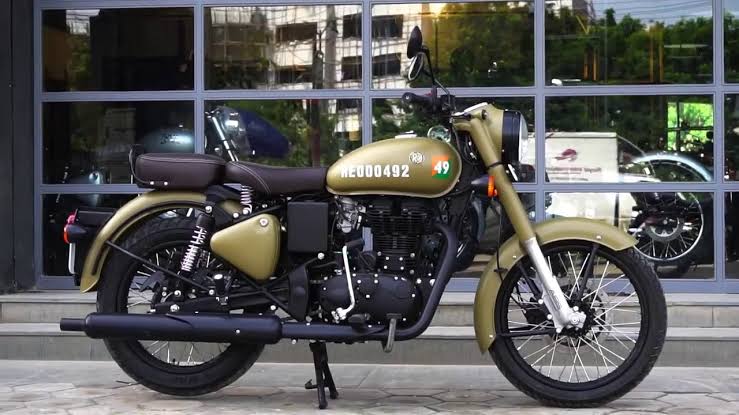
Royal Enfield Bullet Electra 350, 2004
Royal Enfield Classic 350, 2010 model
Logo used from 1995 to early 2020
The Indian government looked for a suitable motorcycle for its police and army, for patrolling the country’s border. The Royal Enfield Bullet was chosen as the most suitable bike for the job. The government ordered 800 units of the 350 cc model.[6][7] In 1955, the Redditch company partnered with Madras Motors in India to form ‘Enfield India’ to assemble, under licence, the 350 cc Royal Enfield Bullet motorcycle in Madras (now called Chennai).[8] The tooling was sold to Enfield India so that they could manufacture components. By 1962, all components were made in India. The Indian Enfield uses the 1960 engine (with metric bearing sizes), Royal Enfield still makes an essentially similar bike in the 350 cc and 500 cc models, along with several different models for different market segments.[9]
In 1990, Royal Enfield collaborated with the Eicher Group, an automotive company in India, and merged with it in 1994.[10] Apart from bikes, Eicher Group is involved in the production and sales of commercial vehicles and automotive gears. Although Royal Enfield experienced difficulties in the 1990s, and ceased motorcycle production at their Jaipur factory in 2002,[11] by 2013 the company opened a new primary factory in the Chennai suburb of Oragadam on the strength of increased demand for its motorcycles. This was followed in 2017 by the inauguration of another new factory of a similar size to the facility at Oragadam (capacity 600,000 vehicles per year) at Vallam Vagadal. The original factory at Tiruvottiyur became secondary, and continues to produce some limited-run motorcycle models.[12][13][14][15]
Royal Enfield announced its first takeover of another company in May, 2015 with the purchase of a UK motorcycle design and manufacturing firm, Harris Performance Products,[16][17] that had previously developed the chassis of the Royal Enfield Continental GT Cafe Racer.[18] Harris work with the UK-based part of Royal Enfield’s development team, who are based at the UK Technology Centre at Bruntingthorpe Proving Ground in Leicestershire. The team was established in January 2015, and moved into their new, purpose-built facility in May 2017. By the end of 2019, the team numbered 155 and carries out the full spectrum of design and development activities, from concept generation and clay design to engineering design, prototyping and validation.
Royal Enfield currently sells motorcycles in more than 50 countries. Royal Enfield surpassed Harley-Davidson in global sales in 2015.[19][20]
2014 Continental GT 535
In August 2015, Royal Enfield Motors announced it is establishing its North American headquarters and a dealership in Milwaukee, Wisconsin, with the intention to offer three bikes, the Bullet 500, Classic 500 and Continental GT 535 Cafe Racer as they feel this engine size represents an underserved market. The dealership will be Royal Enfield’s first company-owned store in the U.S., according to Rod Copes, president of Royal Enfield North America.[21][22] The company wants to establish about 100 dealerships in American cities starting with Milwaukee.
“I live here, so I am biased. But in my mind, Milwaukee is kind of the center of motorcycling in the United States,” said Copes, a former Harley-Davidson executive.[23] “We view this as kind of our first flagship dealership,” he added.[24]
Later in August 2015, parent-business Eicher announced its entry in Indonesia as a part of its global strategy in the mid-sized (250-750 cc) motorcycle segment, initially starting retail operations from a dealership in Jakarta.[25][26] From April to September, 2015, Royal Enfield’s domestic sales were 50% higher than the previous year, despite a declining motorcycle market in India.[27]
In 2017, Royal Enfield added new variants of the Classic 350 and 500 motorcycles. While the Royal Enfield Classic 350 gets Gunmetal Grey as a new color option, the Classic 500 will now come in Stealth Black colour.
Fashion is a popular aesthetic expression at a particular time and in a specific context, especially in clothing, footwear, lifestyle, accessories, makeup, hairstyle, and body proportions. Whereas a trend often connotes a peculiar aesthetic expression and often lasting shorter than a season, fashion is a distinctive and industry-supported expression traditionally tied to the fashion season and collections. Style is an expression that lasts over many seasons and is often connected to cultural movements and social markers, symbols, class, and culture (ex. Baroque, Rococo, etc.). According to sociologist Pierre Bourdieu, fashion connotes “the latest fashion, the latest difference.”
Even though they are often used together, the term fashion differs from clothes and costumes, where the first describes the material and technical garment, whereas the second has been relegated to special senses like fancy-dress or masquerade wear. Fashion instead describes the social and temporal system that “activates” dress as a social signifier in a certain time and context. Philosopher Giorgio Agamben connects fashion to the current intensity of the qualitative moment, to the temporal aspect the Greek called kairos, whereas clothes belong to the quantitative, to what the Greek called Chronos.
Exclusive brands aspire for the label haute couture, but the term is technically limited to members of the Chambre Syndicale de la Haute Couture in Paris.
With increasing mass-production of consumer commodities at Lower prices, and with global reach, sustainability has become an urgent issue amongst politicians, brands,and consumers.
Early Western travelers, traveling to India, Persia, Turkey, or China, would frequently remark on the absence of change in fashion in those countries. The Japanese shōgun‘s secretary bragged (not completely accurately) to a Spanish visitor in 1609 that Japanese clothing had not changed in over a thousand years. However, there is considerable evidence in Ming China of rapidly changing fashions in Chinese clothing. Changes in costume often took place at times of economic or social change, as occurred in ancient Rome and the medieval Caliphate, followed by a long period without significant changes. In 8th-century Moorish Spain, the musician Ziryab introduced to Córdoba[unreliable source]sophisticated clothing-styles based on seasonal and daily fashions from his native Baghdad, modified by his inspiration. Similar changes in fashion occurred in the 11th century in the Middle East following the arrival of the Turks, who introduced clothing styles from Central Asia and the Far East.
Additionally, there is a long history of fashion in West Africa. The Cloth was used as a form of currency in trade with the Portuguese and Dutch as early as the 16th Century. Locally produced cloth and cheaper European imports were assembled into new styles to accommodate the growing elite class of West Africans and resident gold and slave traders.[11] There was an Exceptionally strong tradition of cloth-weaving in Oyo and the areas inhabited by the Igbo people.
The beginning in Europe of continual and increasingly rapid change in clothing styles can be fairly reliably dated. Historians, including James Laver and Fernand Braudel, date the start of Western fashion in clothing to the middle of the 14th century, though they tend to rely heavily on contemporary imagery and illuminated manuscripts were not common before the fourteenth century. The most dramatic early change in fashion was a sudden drastic shortening and tightening of the male over-garment from calf-length to barely covering the buttocks, sometimes accompanied with stuffing in the chest to make it look bigger. This created the distinctive Western outline of a tailored top worn over leggings or trousers.
The pace of change accelerated considerably in the following century, and women’s and men’s fashion, especially in the dressing and adorning of the hair, became equally complex. Art historians are, therefore ,able to use fashion with confidence and precision to date images, often to within five years, particularly in the case of images from the 15th century. Initially, changes in fashion led to a fragmentation across the upper classes of Europe of what had previously been a very similar style of dressing and the subsequent development of distinctive national styles. These national styles remained very different until a counter-movement in the 17th to 18th centuries imposed similar styles once again, mostly originating from Ancien RégimeFrance. Though the rich usually led fashion, the increasing affluence of early modern Europe led to the bourgeoisie and even peasants following trends at a distance, but still uncomfortably close for the elites – a factor that Fernand Braudel regards as one of the main motors of changing fashion.
Albrecht Dürer‘s drawing contrasts a well turned out bourgeoise from Nuremberg (left) with her counterpart from Venice. The Venetian lady’s high chopines make her look taller.
In the 16th century, national differences were at their most pronounced. Ten 16th century portraits of German or Italian gentlemen may show ten entirely different hats. Albrecht Dürer illustrated the differences in his actual (or composite) contrast of Nuremberg and Venetian fashions at the close of the 15th century (illustration, right). The “Spanish style” of the late 16th century began the move back to synchronicity among upper-class Europeans, and after a struggle in the mid-17th century, French styles decisively took over leadership, a process completed in the 18th century.
Though different textile colors and patterns changed from year to year,the cut of a gentleman’s coat and the length of his waistcoat, or the pattern to which a lady’s dress was cut, changed more slowly. Men’s fashions were primarily derived from military models, and changes in a European male silhouette were galvanized in theaters of European war where gentleman officers had opportunities to make notes of different styles such as the “Steinkirk” cravat or necktie.
Marie Antoinette, wife of Louis XVI, was a leader of fashion. Her choices, such as this 1783 white muslin dress called a chemise a la Reine, were highly influential and widely worn
Though there had been distribution of dressed dolls from France since the 16th century and Abraham Bosse had produced engravings of fashion in the 1620s, the pace of change picked up in the 1780s with increased publication of French engravings illustrating the latest Paris styles. By 1800, all Western Europeans were dressing alike (or thought they were); local variation became first a sign of provincial culture and later a badge of the conservative peasant.
Although tailors and dressmakers were no doubt responsible for many innovations, and the textile industry indeed led many trends, the history of fashion design is generally understood to date from 1858 when the English-born Charles Frederick Worth opened the first authentic haute couture house in Paris. The Haute house was the name established by the government for the fashion houses that met the standards of the industry. These fashion houses have to adhere to standards such as keeping at least twenty employees engaged in making the clothes, showing two collections per year at fashion shows, and presenting a certain number of patterns to costumers.Since then, the idea of the fashion designer as a celebrity in his or her own right has become increasingly dominant.
Although aspects of fashion can be feminine or masculine, some trends are androgynous. The idea of unisex dressing originated in the 1960s when designers such as Pierre Cardin and Rudi Gernreich created garments, such as stretch jersey tunics or leggings, meant to be worn by both males and females. The impact of unisex expands more broadly to encompass various themes in fashion, including androgyny, mass-market retail, and conceptual clothing. The fashion trends of the 1970s, such as sheepskin jackets, flight jackets, duffel coats, and unstructured clothing, influenced men to attend social gatherings without a tuxedo jacket and to accessorize in new ways. Some men’s styles blended the sensuality and expressiveness despite the conservative trend, the growing gay-rights movement and an emphasis on youth allowed for a new freedom to experiment with style, fabrics such as wool crepe, which had previously been associated with women’s attire was used by designers when creating male clothing.
The four major current fashion capitals are acknowledged to be Paris, Milan, New York City, and London, which are all headquarters to the most significant fashion companies and are renowned for their major influence on global fashion. Fashion weeks are held in these cities, where designers exhibit their new clothing collections to audiences. A succession of major designers such as Coco Chanel and Yves Saint-Laurent have kept Paris as the center most watched by the rest of the world, although haute couture is now subsidized by the sale of ready-to-wear collections and perfume using the same branding.
Modern Westerners have a vast number of choices available in the selection of their clothes. What a person chooses to wear can reflect his or her personality or interests. When people who have high cultural status start to wear new or different clothes, a fashion trend may start. People who like or respect these people become influenced by their style and begin wearing similarly styled clothes. Fashions may vary considerably within a society according to age, social class, generation, occupation, and geography and may also vary over time. If an older person dresses according to the fashion young people use, he or she may look ridiculous in the eyes of both young and older people. The terms fashionista and fashion victim refer to someone who slavishly follows current fashions.
One can regard the system of sporting various fashions as a fashion language incorporating various fashion statements using a grammar of fashion. (Compare some of the work of Roland Barthes.)
In recent years, Asian fashion has become increasingly significant in local and global markets. Countries such as China, Japan, India, and Pakistan have traditionally had large textile industries, which have often been drawn upon by Western designers, but now Asian clothing styles are also gaining influence based on their ideas.



.jpg)


 Site Title